
AI OS: The Future of Connectivity
- June 26, 2026
- Posted by: Ahmed Elrayes
- Category: Digital Transformation
The current conversation around agentic AI is missing the forest for the trees.
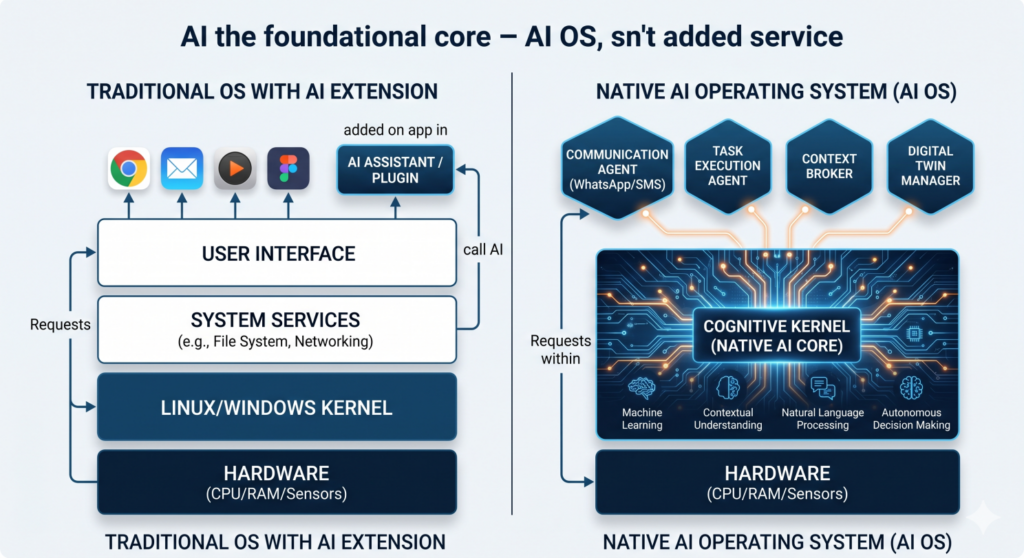
Right now, we are treating AI agents like glorified browser extensions. We download a tool, wrap it in an API, hook it up to a traditional software application, and call it automation. But building an agent that clicks around a legacy app silo is just a patch on old plumbing. It’s a temporary service layer built over operating systems designed in the 1990s.
The real transformation isn’t software running on a device. The real transformation happens when the AI is the device.
When we transition from AI-as-a-service to AI-native hardware and operating systems, the way humanity connects, communicates, and operates will change forever.
The App Store is a Legacy Constraint
For fifteen years, our digital lives have been dictated by the grid of application icons on a glass slab. This application-centric model forces us to act as the manual data routers: copy from the email, open the WhatsApp chat, paste into the CRM, open the banking app to confirm the transfer.
Current agents try to mimic this human behavior. But a true AI Operating System (AI OS) doesn’t use apps; It replaces them with an ecosystem of decoupled cognitive extensions.
In an AI-native OS, a platform like WhatsApp or an enterprise ERP isn’t a heavy application fighting for screen time; it is a secure API gateway. The AI kernel handles the routing, parsing your spoken or implicit intent and orchestrating backend tools silently. The user interface dissolves into a transient canvas, appearing only when complex visual data is actually required, and vanishing the moment the intent is fulfilled.
Stripping the Screen: The Shadow Architecture
Once you strip away the structural need for application windows and manual typing, the physical smartphone itself begins to look like a historic relic. We are moving rapidly toward a post-mobile world of ambient, wearable computing.
Imagine a device footprint that functions as your cognitive shadow “a minimalist smart ring, a sleek circular clip, or a lightweight ear piece” The physical architecture splits into a decentralized two-tier engine:
1. The Edge Micro-Brain
Your wearable doesn’t need to host a massive 70-billion-parameter model locally. Instead, it houses an ultra-efficient, low-power micro-token Neural Processing Unit (NPU). Its sole job is real-time sensory orchestration: continuous voice isolation, biometric intent tracking, and sub-millisecond local feedback loops.
2. The Cloud Macro-Brain (The Superhome Base)
The heavy cognitive lift is offloaded to a private cloud droplet or a dedicated home server. This is where your unconstrained LLM architectures, deep reasoning models, and infinite vector memory spaces reside.
Driven by the sub-millisecond latencies of emerging 6G hyper-pipes, the physical distance between your wearable ring and your private cloud engine effectively disappears. The remote macro-brain executes complex logic, cross-references years of your personal business context, and flits back instructions so fast that the cloud feels like local silicon.
How the World Changes
When intelligence is built directly into the hardware and radio layers, computing shifts from reactive to predictive.
The radio hardware (GSM, Wi-Fi, Bluetooth) is no longer a dumb utility scanning mindlessly and draining battery. The AI kernel actively schedules radio states based on your schedule, routine travel paths, and cognitive load. It moves data ahead of you.
- Contextual Omnipresence: If you walk into an executive briefing, your wearable shadow recognizes the environmental shift. Your cloud macro-brain instantly pages your historical project data, past advisory frameworks, and stakeholder summaries into hot RAM. You are brief-ready before you even open your mouth.
- Unified Intent Execution: Instead of managing 10 different communication streams, you dictate a single fluid intent into the ether: “Send the updated consulting brief to my partner and let them know Im wrapping up” The OS resolves who they are, checks their preferred medium (SMS, email, or a secure enterprise portal), and routes the data seamlessly through the radio bus.
The Next Horizon
We are on the verge of moving away from devices that demand our undivided attention. Technology will stop being an destination we navigate to, and instead become a seamless, invisible layer over reality.The future of connectivity isnt a better app marketplace; it’s an environment where your hardware, your network, and your cognitive memory are completely unified. The screen is disappearing, and the era of the ambient AI OS is beginning.
#ArtificialIntelligence #TechInnovation #AIOS #FutureOfConnectivity #DigitalTransformation #AgenticAI
Assess your AI readiness using “Transformation Compass” https://aynrmc.com/self-assessment/
